

By Capt. Dmytro Popov, Business Partner at Perfomax.io
Crew Transfer Vessels (CTVs) are at the frontline of offshore wind operations. They move technicians, supervisors, and equipment between shore, Wind Turbine Generators (WTGs), and Offshore Substations (OSS), often under demanding weather and operational conditions. In this environment, vessel availability, transfer safety, fuel efficiency, and machinery reliability are not separate concerns — they are tightly connected.
As offshore wind farms expand farther from shore and asset utilization expectations increase, CTV operators need more than traditional noon reports, isolated alarms, or manual performance checks. They need a live operational picture of the vessel: how the engines are performing, how much fuel is being consumed, how systems are behaving under load, and how the vessel interacts with offshore structures during transfer operations.
CTV challenge: operational pressure in a narrow performance window
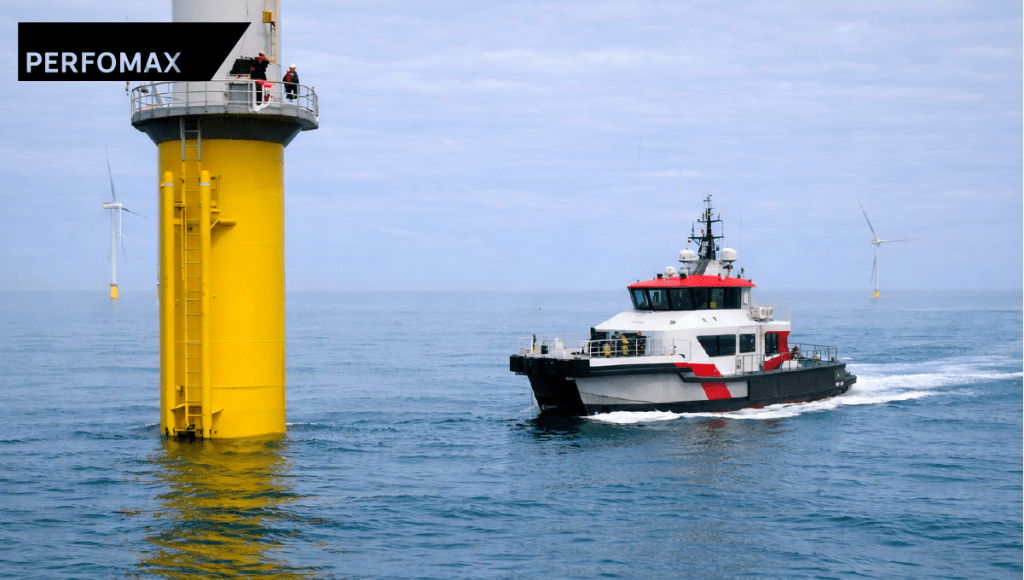
CTVs operate in one of the most repetitive yet risk-sensitive patterns in offshore marine logistics. A typical working day can involve multiple transfers, repeated acceleration and deceleration, push-on maneuvers at boat landings, dynamic power demand, and continuous pressure to maintain schedule reliability.
This creates several operational challenges at once:
- engine and propulsion loads vary constantly;
- fuel performance can drift without being obvious from manual reporting;
- minor machinery deterioration can remain hidden until it causes downtime;
- transfer quality depends not only on seamanship, but also on vessel behavior at the landing interface;
- any loss of availability directly affects technician access, project continuity, and charter efficiency.
For offshore wind operators, this means the real KPI is not only speed or fuel per hour. It is the vessel’s ability to perform safe, repeatable, and efficient transfers while minimizing technical surprises.
From data collection to real operational awareness
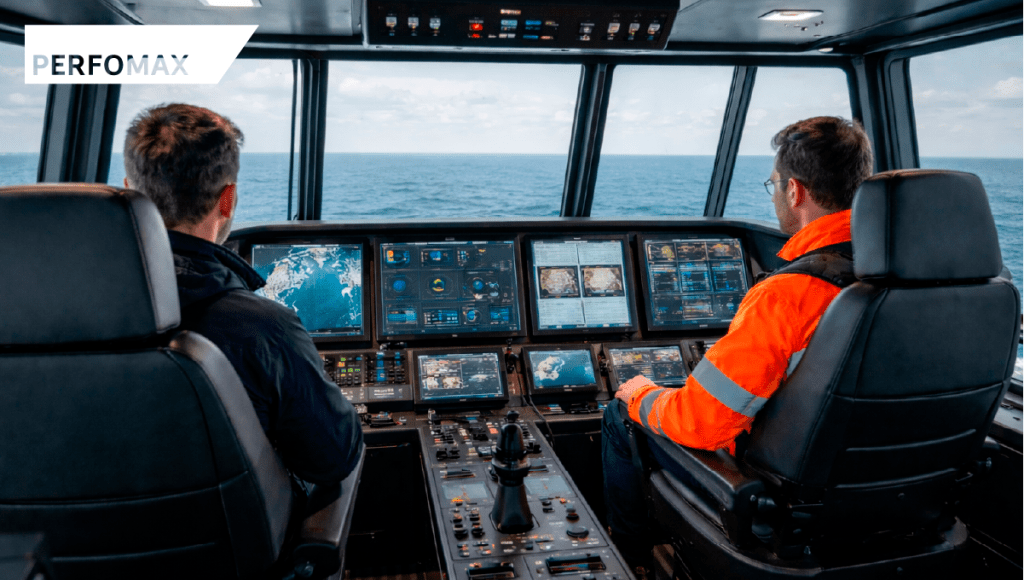
Perfomax outlines a digital stack that is highly relevant for CTV operations: machinery health monitoring, real-time alarms, voyage and fuel analytics, fleet KPI comparison, route and weather visualization, and optional monitoring of additional sensors and mission-specific parameters:
Machinery condition monitoring.
Live parameters from engines, generators, gearboxes, cooling systems, fuel systems, and auxiliary equipment can be trended and compared, helping crews and shore teams identify abnormal patterns before they develop into failures, by highlighting alarm history, condition-based scoring, and optional visual machinery representations for easier troubleshooting.
Fuel and voyage analytics.
CTVs are schedule-driven assets, so fuel consumption needs to be understood in context: vessel speed, engine load, route profile, weather, transfer cycles, idle time, and operational mode. Perfomax do the fuel consumption modelling, vessel speed comparison, and digital trip baselines for comparing actual versus expected consumption. That is essential for identifying avoidable overconsumption and improving consistency across voyages and sister vessels.
Fleet-level benchmarking.
Offshore wind operators often manage multiple vessels or compare performance across charters, campaigns, and regions. The proposal includes fleet KPI dashboards, sister-vessel comparison, and custom metrics, which can support a more objective understanding of which vessels are operating efficiently and which need technical or operational attention.
Why push-on force measurement in kN matters
One of the most valuable optional capabilities for CTVs is the ability to measure force during push-on in kilonewtons (kN).
During a standard bow transfer, the CTV pushes its bow fender against the boat landing on a WTG or another offshore structure to create a stable interface for personnel transfer. Industry guidance shows that this push-on force is central to transfer stability: too little force can allow relative movement between vessel and structure, while too much force can create unnecessary structural loading, increase wear, or affect safe positioning during vessel-to-vessel or structure access operations. G+ guidance notes that a CTV can exert a bollard push force in the order of 5–10 tonnes, which is roughly 49–98 kN, depending on conversion and operating conditions:
- Safer transfers to WTG boat landings
Technicians often step from the CTV onto a ladder or landing arrangement. Industry guidance emphasizes the importance of safe approach, controlled vessel movement, and stable contact at connection. Measuring actual push-on force gives operators a view of how consistently the vessel is holding against the structure, rather than relying only on feel, habit, or post-event judgment. - Protection of boat landing structures and fender systems
Boat landings are engineered interfaces, not simply contact points. IMCA’s standardised boat landing work and Carbon Trust guidance both reflect how seriously the industry treats fender impact loading, clearances, and geometry standardisation. Tracking push-on force in kN helps operators understand real contact loads, reduce avoidable overloading, and support evidence-based maintenance planning for both vessel fenders and landing structures. - Improved transfer repeatability between turbines and substations
WTGs and OSS can differ in geometry, local exposure, tidal window, and operational use. Offshore substations are especially important because they are critical nodes in the export and distribution chain of the wind farm. Measuring push-on force helps standardize transfer practice across assets and crews, making performance more repeatable from one landing to another. Offshore substations are the hubs that collect power from turbines and route it onward, so reliable access is operationally significant. - Better operator feedback and training
A measured kN value turns transfer quality into an observable parameter. This can improve bridge decision-making, support operator coaching, and help identify how sea state, heading, trim, loading condition, or propulsion response affect the push-on window. Over time, this creates a more data-driven transfer culture. - Correlation with fuel, thrust, and machinery loading
Push-on force is not an isolated safety metric. It can be connected to propulsion demand, engine load, hybrid battery support, and transfer duration. The attached proposal specifically mentions an option to acquire data from battery-hybrid propulsion systems and to calculate push force based on engine torque/rpm realisation, or by using a dedicated sensor array. This creates a direct bridge between transfer performance and machinery analytics.
In short, measuring push-on force in kN transforms a critical transfer maneuver from an assumed skill into a monitored operational parameter.
Beyond monitoring: turning data into savings
For CTV operators, the most valuable result is not a single dashboard. It is the ability to answer key operational questions with evidence:
- Is this vessel consuming more fuel because of conditions, or because of performance drift?
- Are repeated alarms showing the start of a machinery issue?
- Are transfers being executed within a stable and consistent force envelope?
- Is one vessel, crew, or route performing better than another?
- Are we seeing avoidable wear at the bow landing interface?
- Can we prove operational improvement over time?
That is where digital monitoring begins to move from “nice to have” into core vessel management.

Capt. Dmytro Popov Business Partner of Perfomax
Master Mariner with strong background focused on Business Development for Offshore and Yacht industry.


