In recent conversations with technical managers, fleet managers, and offshore operations teams, one topic has come up repeatedly: what actually represents good machinery condition monitoring practice for offshore and maritime assets?
This is not a simple question. Preventive and predictive maintenance in heavy industry is difficult because offshore assets operate under high load, limited access, tight schedules, and harsh environmental conditions. A light machinery fault onshore may be treated as a planned maintenance item. Offshore, the same issue can create operational delays, safety concerns, charter-party pressure, or expensive downtime.
There are several reasons why machinery monitoring in offshore operations is complex:
- Offshore equipment works under changing and often severe operating conditions. Engines, pumps, compressors, thrusters, gearboxes, cranes, and hydraulic systems are continuously affected by load, temperature, humidity, vibration, fuel quality, lube oil condition, sea state, and operating mode.
- Many failure drivers are not directly visible to a single monitoring tool. Ambient air conditions, fuel contamination, lube oil degradation, wiring quality, control-system faults, maintenance history, and crew operating practices can all influence machinery health.
- Human factors remain important. Data can be misinterpreted, operating conditions may not be recorded correctly, and onboard teams often do not have enough diagnostic tools or time to investigate every alarm in depth.
Every new monitoring technology goes through a period of high expectations. It is presented as scalable, simple, and able to solve a wide range of operational issues. In heavy industry, however, these technologies eventually meet the reality of complex assets, legacy systems, limited crew time, and harsh working environments.
Vibration analysis is a good example. It has become one of the most recognized tools in predictive maintenance, and for good reason. It can provide valuable information about rotating machinery. But it should be treated as one layer of the diagnostic process, not as the full answer.
1. What vibration analysis does well
Vibration monitoring is strong for rotating mechanical faults, especially:

For equipment such as pumps, motors, compressors, gearboxes, fans, and turbines, vibration analysis can be very effective. It provides a direct signal from the mechanical behavior of the machine. When properly installed, calibrated, and interpreted, vibration monitoring can help maintenance teams identify developing mechanical problems before they become failures.
In simple terms:
Vibration is a valuable symptom signal. It tells us how the machine is physically responding.
However, a symptom is not always the same as a root cause. That distinction is critical in offshore and maritime operations.
2. Main weakness: vibration detects symptoms, not full operational cause
A vibration sensor can say: this machine current state is not normal.
But it often cannot confidently say: The vibration is caused by poor combustion, a wrong operating mode, fuel quality issue, propeller cavitation, overload, cooling degradation, lube oil problem, sea state, operator behavior, or a mechanical defect.
This is where vibration-only monitoring can become weak. It may detect that a machine is under stress, but without additional operational data, it may not explain why the stress is happening.
For example, high vibration on a marine engine may come from several different sources:

This matters because offshore crews do not need more isolated alarms. They already operate in a high-workload environment. What they need is diagnostic support that helps them understand the likely cause, severity, and recommended action.
The real value is not simply detecting abnormal vibration. The real value is causality analysis: understanding the root cause of the abnormal condition and its operational impact.
What vibration analysis sales managers don’t want you to know?
3. Maritime offshore assets weaknesses of vibration-only monitoring
A. Vessel conditions constantly change
A factory pump may operate at relatively stable speed, load, and environmental conditions. A vessel does not. Offshore vessels continuously change operating mode, engine load, RPM, speed, draft, trim, thruster demand, auxiliary load, and exposure to wind, waves, and current.

Because of this, simple vibration thresholds can be unreliable. A vibration level that is normal during maneuvering may be abnormal during steady sailing. A vibration spike during bad weather may not indicate equipment failure. Without operational context, the system may create false alarms or miss early-stage faults.
This is a major issue in offshore operations, where the cost of unnecessary alarms is not only technical. It affects crew workload, maintenance planning, and confidence in the monitoring system.
B. Vibration alone cannot explain consumption vs power output dynamics
For maritime customers, one of the biggest business pains is consumption and impact of the machinery condition on the performance. Vibration sensors do not directly explain:
- why fuel consumption increased,
- whether the vessel is operating outside optimal range,
- whether hull/propeller fouling is affecting performance,
- whether the engine is overloaded,
- whether crew operation is inefficient,
- whether route, weather, or loading condition is the cause.
Our team perspective is that only by combining vibration with engine telemetry, vessel speed, fuel rate, RPM, load, alarms, temperatures, pressures, and operational mode there will be real results that bring value to the real operations and budget improvement.
C. Shipboard installation is difficult
Vibration sensors need correct placement, mounting, calibration, and protection. On vessels, this becomes harder because of:
- humidity and salt exposure,
- engine-room heat,
- cable routing limitations,
- class/cybersecurity restrictions,
- limited crew time,
- access problems around engines, pumps, thrusters, and shaftlines,
- risk of sensor damage during maintenance.
Complex approach of PERFOMAX is more scalable because we can extract data from existing machinery control systems, meters, navigation systems, and other interfaces, while using vibration as an additional signal where useful instead of forcing installation of them for the sake of increasing the check.
4. Vibration-only vs Complex analysis
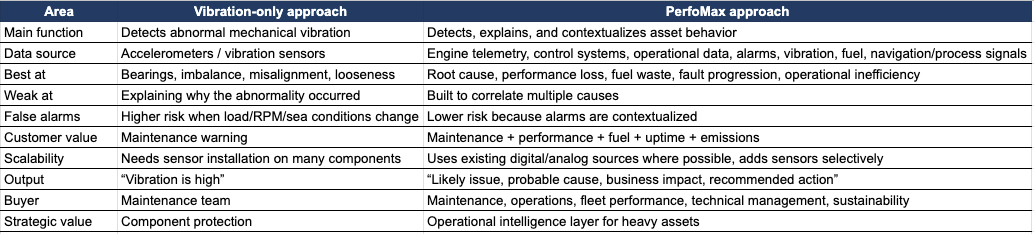
5. Why vibration is not enough for “source of issue”
Vibration is a response signal. It is the result of something happening inside the machine or operating environment. But the same vibration pattern can be caused by several different sources.
For example:
- High vibration on a generator
Vibration-only conclusion: “Generator vibration exceeds threshold.”
PERFOMAX conclusion: “Generator vibration increased only during high load, while coolant temperature and exhaust temperature also rose. The issue is linked to load/thermal stress rather than pure bearing deterioration.”
- High vibration on a pump
Vibration-only conclusion: “Pump vibration abnormal.”
PERFOMAX conclusion: “Pump vibration coincides with low suction pressure and unstable flow. Likely cavitation/process condition, not only bearing damage.”
This is the commercial value: complex approach actually reduces investigation time and unintentional errors that could happen onboard the vessel.
6. Where vibration vendors are vulnerable in sales discussions
A vibration-focused competitor can sound strong because they can show spectra, thresholds, AI models, and predictive maintenance dashboards. But the weakness is usually in the customer conversation:

7. Final thoughts
Vibration analysis is a valuable condition monitoring tool. It should be trusted when it is applied correctly and interpreted by competent engineers. It is especially useful for rotating machinery and mechanical fault detection.
But vibration analysis is weak as a standalone root-cause and machinery performance tool.
In offshore and maritime operations, equipment is affected by changing load, fuel quality, operating mode, weather, crew decisions, power demand, process conditions, and maintenance history. A vibration signal alone does not capture all of that complexity.
A partial solution can still leave the main problem unresolved. In some cases, it can even add workload to the crew by producing alarms that require additional investigation without providing enough diagnostic context.
This is why the next generation of predictive maintenance in offshore and maritime is moving from isolated sensor monitoring to operational intelligence.
The goal is not only to know that a machine is vibrating.
The goal is to understand:
- why the asset is under stress,
- whether the issue is mechanical, operational, or environmental,
- how it affects fuel consumption and performance,
- what risk it creates for uptime and safety,
- what action should be taken.
Causality analysis is one of the most difficult areas in heavy industry because it requires more than data. It requires engineering understanding of machinery, thermodynamics, vessel operations, maintenance practice, and regional operating conditions.
A vessel operating offshore Brazil is not the same as a vessel operating in Norway, West Africa, the Gulf of Mexico, or the Middle East. The environment, operating profile, crew practice, fuel quality, maintenance approach, and client requirements are all different.
That is why predictive maintenance should be done in an engineering way — by combining the right signals, understanding the asset, and converting data into practical decisions.
Vibration monitoring tells you when the machine is shaking. Operational intelligence tells you why the asset is under stress — and what to do about it.