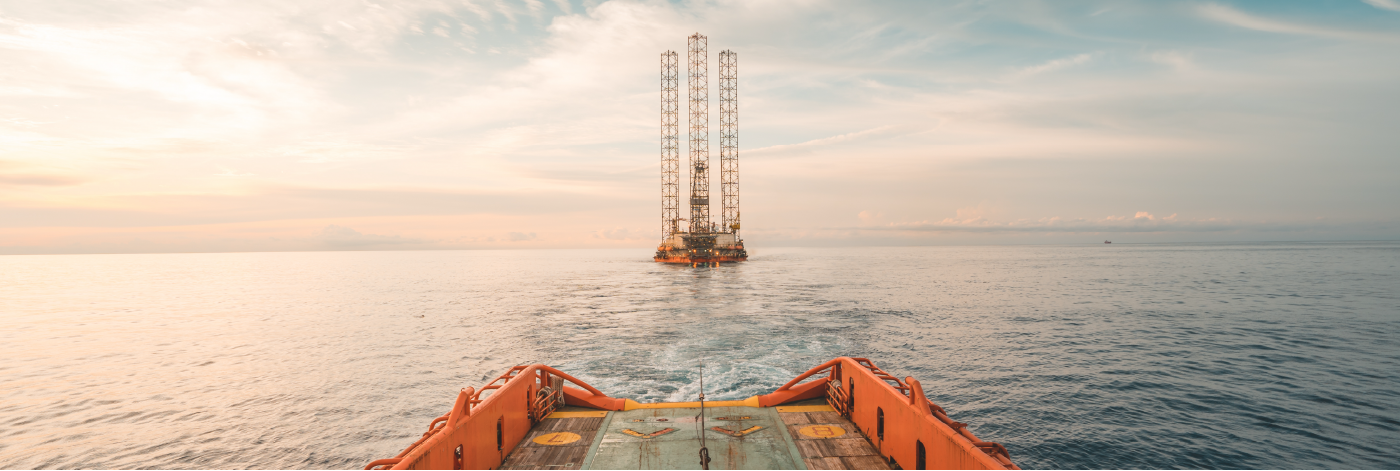
Offshore towing can look deceptively simple from the outside: one vessel connects a towline to another vessel, rig, barge, floating structure, or subsea asset, and pulls it from one location to another.
In reality, offshore towing is one of the most complex operations in the marine and offshore industry.
The reason is simple: towing is not the performance of one vessel. It is the physics of two or more dependent floating objects moving together, connected by a towline, while both are exposed to wind, waves, current, and constantly changing environmental forces. The towing vessel, the towed object, the towline, the winch system, the propulsion system, and the surrounding environment all interact with each other.
That interaction is exactly what makes towing performance analysis so difficult.
Towing is a coupled system, not a single-vessel operation
In normal vessel performance analysis, we often look at speed, fuel consumption, engine load, propulsion efficiency, weather impact, and hull resistance. This is already complex enough.
During towing, however, the vessel is no longer operating alone.
The Anchor Handling Tug Supply vessel, or AHTS, is affected not only by its own hull resistance and environmental loads, but also by the resistance of the towed object. The towed object may have a completely different shape, draft, wind area, hydrodynamic behavior, and motion response compared with the towing vessel.
This means the towing vessel and the object being towed do not always behave in the same way.
They may respond differently to waves. They may drift differently under current. They may be affected differently by wind. They may accelerate, decelerate, yaw, roll, pitch, and heave in different phases. When this happens, the towline becomes the physical connection transferring these differences into dynamic loads.
That is where the operation becomes complicated.
When the towed object is not synchronized with the vessel

One of the key risks in offshore towing is motion and distance mismatch.
The longer the wire the better it is for the stability of the process, but it has specifics. If the towing vessel and the towed object are not synchronized with the waves, additional resistance can be created. For example, the towing vessel may be moving down a wave while the towed object is climbing the next one. Or the vessel may be reducing load at one moment while the towed object is creating a peak load in the towline.
This can cause sudden changes in towline tension.
Those changes do not only affect towing speed and fuel consumption. They also affect the winch system, towing gear, propulsion load, vessel handling, and safety margins. A towing operation that looks stable based on vessel speed alone may actually be creating high cyclic loads in the towline and winch system.
This is why towing performance cannot be analyzed only by looking at the towing vessel’s fuel consumption or engine power. The physical behavior of the towed object must also be understood.
Environmental forces can create a chain reaction
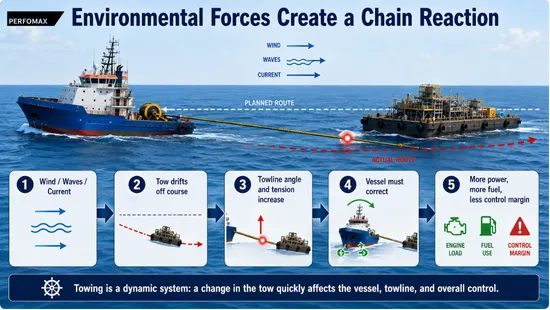
Wind, waves, and current do not act equally on the towing vessel and the towed object.
A large floating object with a high wind area may start drifting away from the planned course. A barge or floating structure may have poor directional stability. A rig, hull section, or heavy offshore object may react strongly to beam seas or cross-current. Once the towed object starts moving off course, the towline angle changes.
That towline angle then affects the towing vessel.
The vessel may need to correct heading. More rudder or thruster input may be required. Propulsion demand increases. Fuel consumption rises. The winch may see higher side loads or fluctuating tension. Speed may drop. In more severe cases, the vessel may lose effective control of the tow, especially if power reserve, bollard pull margin, or environmental limits were overestimated.
This is the chain reaction that makes offshore towing so demanding:
- The environment affects the towed object.
- The towed object changes the towline force.
- The towline force affects the towing vessel.
- The vessel reacts through propulsion, steering, and winch control.
- That reaction changes the entire towing system again.
At this point marine warranty surveyor, in case his presence is required by the insurance, supervising the operation might insist to alter the tow plan.
This is not a static calculation. It is a dynamic process. In a constantly changing environment.
Multi-vessel towing makes the problem even more complex

Some offshore towing operations involve two or three vessels towing or controlling one large object. In these cases, the complexity increases significantly.
Each vessel has its own propulsion characteristics, heading, fuel consumption, bollard pull, towline length, winch behavior, and response to sea conditions. The vessels must work together, but they are not identical. Even small differences in speed, towline tension, heading, or response time can redistribute load between vessels.
One vessel may unintentionally take more load than planned. Another may operate below its effective contribution. Towline angles may change. The towed object may yaw or drift. The total system may become inefficient or unstable, even though each vessel individually appears to be operating normally.
This is why multi-vessel towing cannot be properly understood by analyzing each vessel separately. The complete towing arrangement must be analyzed as one connected physical system.
Why speed and fuel data are not enough

A common mistake in towing performance analysis is to rely only on standard vessel data: speed over ground, fuel consumption, engine power, RPM, and perhaps weather data from a general source.
This is not enough.
During towing, high fuel consumption may be caused by many different factors. It may be caused by increased hull resistance of the towing vessel. It may be caused by the hydrodynamic resistance of the towed object. It may be caused by towline angle, current, wave direction, poor course keeping, excessive winch tension, inefficient propulsion loading, or the towed object moving out of phase with the vessel.
Without the right data, it is difficult to separate these effects.
For example, if fuel consumption increases by 15%, the reason may not be “bad vessel performance.” It may be that the towed object is drifting, creating a larger towline angle and additional resistance. Or the vessel may be towing against a current while the object is exposed to beam wind. Or dynamic towline tension may be forcing the propulsion system to operate inefficiently.
The vessel’s data alone can show that performance changed. It cannot always explain why.
What proper towing performance analysis should include

A proper offshore towing performance analysis requires a wider data set and a physical understanding of the complete operation.
It should include real-time or high-frequency data from the main vessel systems, including propulsion, engines, fuel flow, shaft power where available, thrusters, heading, speed, and navigation data. It should also include winch and towline information such as line tension, payout, towline length, and load variation.
Environmental data is equally important. Wind speed and direction, wave height, wave period, wave direction, current speed and direction, and water depth can all change the towing condition. These forces must be considered not only against the towing vessel, but also against the towed object.
The analysis should also include physical modelling of the towing process. This means estimating or modelling resistance, towline forces, towline angle, added resistance in waves, drift forces, and the interaction between the towing vessel and the towed object.
Only by combining operational data, environmental data, winch data, propulsion data, and physical modelling can we understand what is really happening.
The goal is not only to measure performance, but to explain it in real-time

Good towing performance analysis should answer practical questions:
- Why did fuel consumption increase?
- Was the vessel underperforming, or did environmental forces increase tow resistance?
- Was the towed object drifting from the intended track?
- Did towline tension remain within safe and efficient limits?
- Was the propulsion system operating efficiently for the actual towing load?
- Did the operation have enough power and bollard pull reserve?
- Were waves and tow direction creating additional dynamic loads?
- How did the winch system respond to changing tension?
- Could a different heading, speed, towline length, or operational strategy reduce consumption and improve safety?
These are the questions that matter during real offshore operations. You can only optimise within a time frame of dozens of minutes even 1 hour intervals are not efficient.
The purpose of towing performance analysis is not just to create a report after the job is complete. It is to understand the operation while it is happening, identify developing inefficiencies or risks, and support better operational decisions.
Why this matters for safety and efficiency

Offshore towing is often performed under commercial pressure. Weather windows are limited. Fuel cost is significant. Vessel availability matters. The towed object may be extremely valuable. Delays can be expensive, and operational mistakes can create major safety risks.
A small error in understanding towing performance can lead to wrong decisions.
If the resistance is underestimated, the vessel may not have enough power reserve. If environmental drift is ignored, the tow may move away from the planned route. If towline loads are not properly understood, the winch and towing gear may be exposed to unnecessary stress. If fuel consumption is analyzed without considering the towed object, the vessel may be wrongly blamed for poor performance.
This is why towing performance analysis must be treated as a specialist discipline. It is not only marine operations. It is not only vessel performance. It is a combination of hydrodynamics, propulsion analysis, environmental modelling, winch monitoring, operational data, and real-time decision support.
Offshore towing only looks simple from a distance

From a distance, offshore towing may look like one vessel pulling another object across the sea.
In reality, it is a continuously changing physical system. The towing vessel and the towed object are connected, but they do not always behave as one. Waves, wind, and current act on both in different ways. The towline transfers forces between them. The winch system absorbs and responds to those forces. The propulsion system carries the load. The vessel crew must control the entire system safely and efficiently.
That is why proper towing performance analysis requires much more than standard vessel monitoring.
It requires real-time data from all major vessel systems. It requires environmental data. It requires winch and towline data. It requires propulsion analysis. And most importantly, it requires physical modelling of the towing process itself.
My team at PERFOMAX is taking the approach that we believe solves the issue in the real world: not looking at the vessel in isolation, but analyzing the complete towing system — vessel, tow, winch, propulsion, and environment — to understand what is really happening and how offshore towing operations can be performed more safely and efficiently.