Table of Contents
- From the maritime and offshore industry’s perspective, what is a DPS?
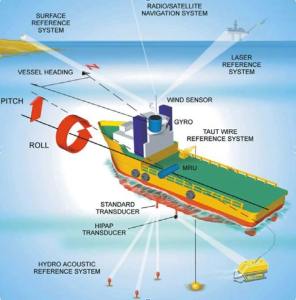
Dynamic Positioning (DP) Systems are automated systems that maintain a vessel’s position and heading using thrusters and propellers, without anchoring. Classified by levels of redundancy and fault tolerance (DPS-0 to DPS-3 in ABS; Class 1 to Class 3 in DNV), DP systems are critical for offshore operations like drilling, construction, and logistics. They ensure operational safety in harsh conditions by providing fail-safes to maintain station-keeping after equipment failures, fire, or flooding. They are a necessity for structures that aren’t moored or where solid grounding for anchor laying is impossible in sites such as deep sea mineral nodule exploration or oilfield drilling.
Thereby these are a lifeline of the offshore industry’s greatest assets and include:
Mobile Offshore Drilling Units (MODUs): These require DP systems to maintain station-keeping during drilling operations in deep waters.
Construction and Project Vessels: Vessels involved in offshore construction, such as pipelaying or heavy lifting, require them for precise positioning.
Logistics Vessels: These vessels, providing support to offshore platforms, may need DP systems for maintaining safe distances and accurate positioning during supply operations.(especially in Nordic rough seas, where such offshore operations are most profitable)
Other Vessel Types: This includes accommodation vessels, wind farm support vessels, and diving support vessels. DP systems are critical for maintaining safety and operational efficiency in dynamic offshore conditions.
- Types of DPS and what their use cases are: For DPS-0 to DPS-3
The Dynamic Positioning (DP) systems built and tested in compliance with ABS Guidelines and relevant Rules may be assigned classification notations based on system redundancy, as per the owner’s request.
DPS-0: Centralized manual position control with an automatic heading.
DPS-1: Automatic DP system with manual backup.
DPS-2: Automatic DP with redundancy, capable of maintaining position after a single fault (excluding compartment loss).
DPS-3: Same as DPS-2 but includes protection against compartment loss due to fire/flooding. Enhanced system (EHS) and station-keeping performance (SKP) notations are available (refer to Sections 8 and 9). Optional notations: ISQM and SSV (Section 11).
These classifications are originally derived from the structural classification requirements set by IMO.

- Why have a DPS?
If you are looking for an installation that will ensure the following three things for your offshore structure/vessel :
- Operational efficiency
- Environmental risk reduction
- Cost-effectiveness
Then DP systems are the correct choice.
The range of operations where these can find a use case in the offshore industry is practically limitless, be it wind farming, energy generation plants, subsea pipelaying units, etc. By eliminating anchoring, DP systems reduce environmental damage to marine ecosystems and allow access to previously inaccessible areas for further exploration and utilization.
The baseline is that DPS is what you go for when you need precision in your operations while ensuring the survivability of your system in risky environments.

- Impact on fuel consumption of DPS during its operation:
Using empirical relations and MARPOL Annex VI as reference for a 55000DWT tanker retrofitted and rebuilt into an FPSO, where we assume a 12000 nautical mile distance of annual distance traveled, we find using reduction factors for 2025 that an 11% reduction in CII value is expected, however, analytics results from mathematical models simulating use of DPS show that a reduction of greater than 13.68% might be obtained.
This, although calculated using conservative estimates, strongly suggests the effectiveness of DPS for offshore vessels.
The dynamic positioning system’s principle of operation ensures that the load on the primary mover is more distributed into the DPS subsystems to allow for optimal operational efficiency.

- DPS digitization impacts:
Being an automated system, the current DPS solutions available, from the market leaders in manufacturing are quite efficient by themselves. But ask yourself this, are operational innovations such as joystick-enabled thruster control, and ease of maintenance, the only innovations that are sufficient to ensure your future safety?
If you ask our experts, we’ll let you know from our honest experience with mariners operating in the offshore industry, that the next big wave about to hit it won’t be from the ocean, but rather the one of automation and SHIP-4.0. To sail through them, data analytics-based prediction models like Perfomax are what can help your situation the best. It allows you to make the best-use of your thruster capabilities and sea-state-based predictions that allow for maximum operational efficiency of your existing DPS.
Discover more from PerfoMax
Subscribe to get the latest posts sent to your email.